Origins in the Miocene Epoch
The rock faces enclosing Praia da Marinha are formed primarily of Lagos-Portimão Formation calcarenites—fossil-rich biocalcarenites and yellowish marlstones laid down during the early to middle Miocene epoch, roughly 16 to 23 million years ago. At that time, a warm shallow sea submerged what is now southern Portugal, accumulating the shells of bivalves, gastropods, sea urchins, and benthic foraminifera.
As tectonic pressures gradually lifted the Iberian plate and ocean levels shifted, these marine sediments compressed into dense stone layers. Today, hikers and beachgoers can clearly observe horizontal sedimentary banding alternating between hard, cement-rich limestone ridges and softer sand-rich beds prone to preferential weathering.
Mechanical Erosion and the Birth of Sea Arches
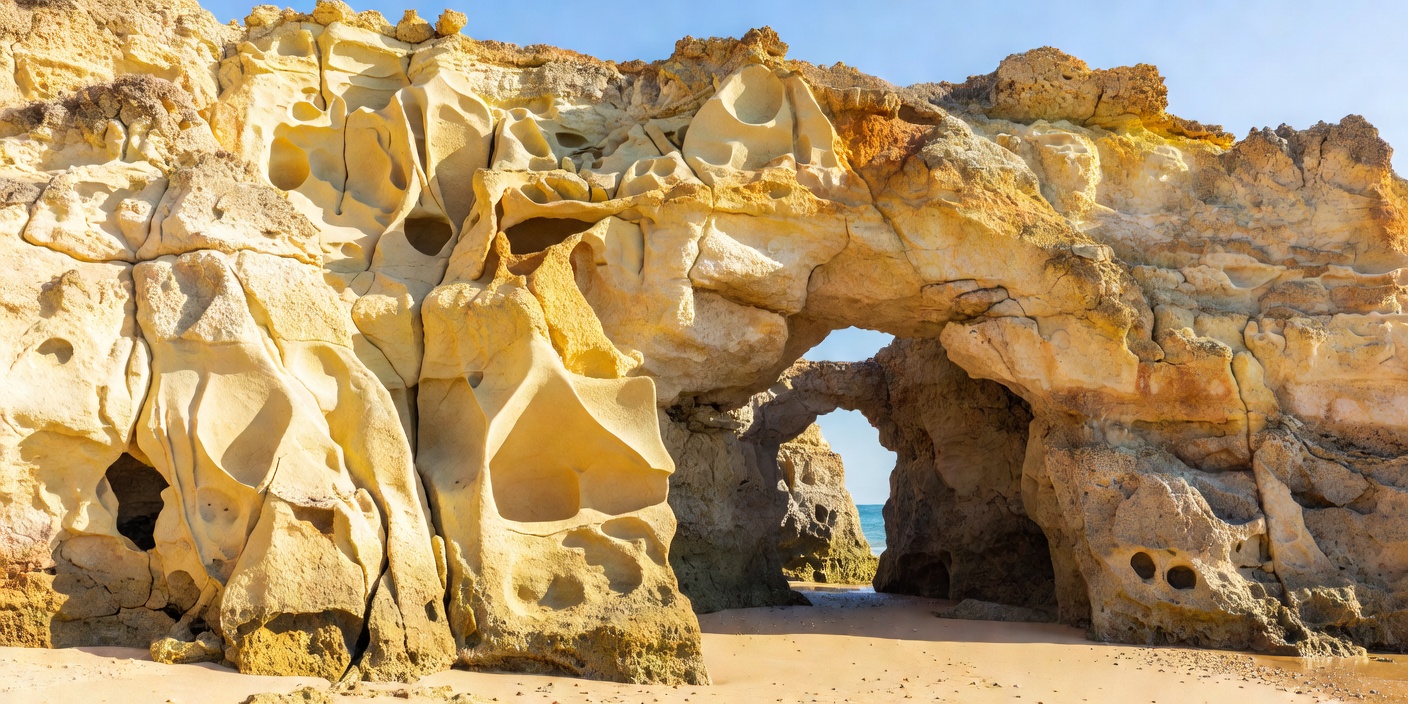
The signature landforms at Marinha—including its arches and detached stacks—are products of persistent marine mechanical erosion paired with chemical dissolution. Atlantic wave action attacks vertical joints and fissures along the cliff base. Compressed air and hydraulic pressure weaken these zones into notch-caves.
When wave action penetrates a narrow headland from two sides, caves eventually meet to form a natural sea arch. Over decades, as the arch roof widens and fractures through gravitational stress, the unsupported lintel collapses into the surf, leaving freestanding columns known as sea stacks (leixões).
"The double arch of Praia da Marinha, often called the 'M-Rock' or Arcos Naturais, stands as a transient stage in coastal mechanics: what is today a cathedral-like arch will eventually collapse into standalone pillars."
Karst Features: Algares and Sinkholes
Beyond sea-level wave action, rainwater slightly acidified by atmospheric carbon dioxide seeps down through surface fissures from the clifftops. This slow acid dissolution carves subterranean chambers and vertical shafts known locally as algares.
Several major algares punctuate the headlands directly above Praia da Marinha. When subterranean caverns expand until their limestone roofs can no longer support their own weight, they collapse downward, creating open-air sinkholes. From the clifftop trail, visitors can peer into enclosed pits where daylight illuminates crashing waves dozens of meters below.
Fossil Beds and Micro-Stratigraphy
The exposed rock layers display notable concentrations of macro-fossils. Embedded throughout the fallen boulders are the calcified remains of ancient marine pectinids (scallops), bryozoan colonies, and echinoid spines. These fossil layers are protected under Portuguese environmental law; visitors are required to observe them in situ without chiseling, prying, or removing specimens from the beach.
Understanding Rockfall Hazards
Because coastal erosion is continuous and erratic, the very processes that create these sculpted vistas also cause unpredictable cliff detachment. Heavy winter rains saturate the porous limestone, increasing internal pore pressure and causing slab failure along vertical fractures.
Official safety signs posted by the Portuguese Environment Agency (APA) mark active instability zones. Visitors are strongly advised to spread beach towels well away from vertical cliff walls—at least a distance equal to 1.5 times the cliff height.
Comparison: Marinha Formations vs Other Algarve Cliffs
| Geological Feature | Praia da Marinha | Ponta da Piedade | Cabo de São Vicente |
|---|---|---|---|
| Primary Rock Type | Calcarenite & Yellow Marl | Karstified Biocalcarenite | Hard Jurassic Dolomitic Limestone |
| Cliff Height Range | 25 – 35 meters | 15 – 25 meters | 60 – 75 meters |
| Dominant Formation | Twin Arches & Sea Stacks | Intricate Grottos & Tunnels | Sheer Vertical Sea-Cliffs |
| Dominant Palette | Warm Ochre & Golden Sand | Orange-Red & Terracotta | Dark Grey & Weathered Stone |